This article was first published June 12, 2026, on Medium and in The Existentialist Republic.
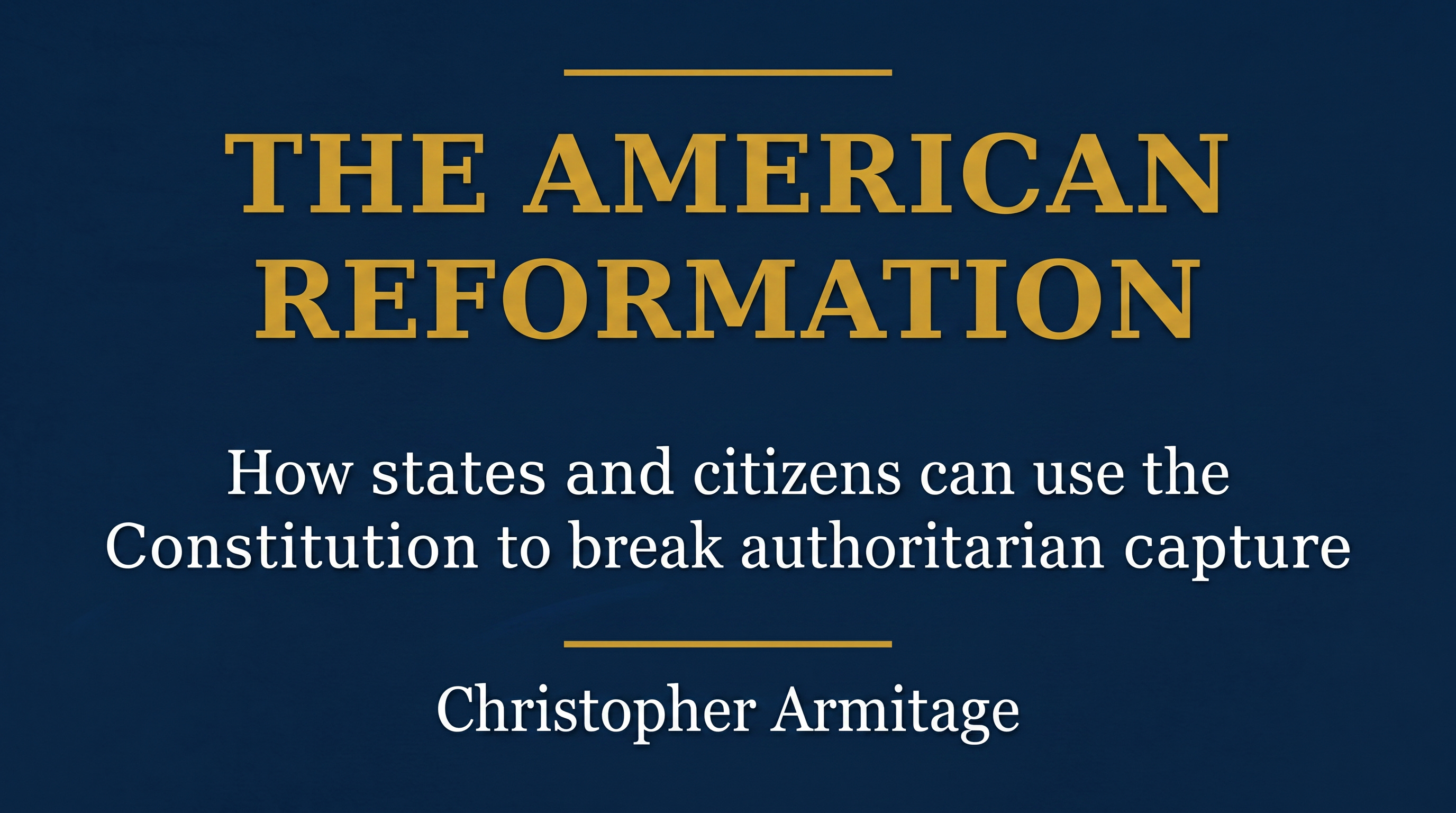
Over the course of my career, I’ve been building this framework one essay and one academic paper at a time, without knowing the pieces would form a single concept. As of today, that framework is a single book: sixteen chapters, ordered so each builds on the last.
From the back of the book:
The founders built the United States as a country of many governments. Power was spread across the states, the cities, and the counties, so that no single center could ever seize the whole. They built it this way for many reasons, and one of the most important was defense: a republic where authority is divided cannot be captured all at once, because there is no single throne to take.
That design still works today, and most people have never been shown how to use it.
A state can decline to enforce a federal directive it judges unlawful. It can build its own institutions, its own banks, its own public systems, beyond the reach of a hostile federal government. Your state can prosecute a federal official who breaks state law, and no presidential pardon can undo a state conviction. Cities, counties, prosecutors, and ordinary citizens each hold a piece of this power. All of it has deep precedent, used by Americans across the political spectrum, in every era, to protect the people from tyranny.
This book compiles years of work as a journalist and an academic into a single framework for how states and local governments can answer the threat of authoritarian capture. It maps the tools, traces the precedent behind each one, and shows how scattered acts of refusal, construction, and accountability combine into something a captured government cannot overcome.
The result is not a revolution but a reformation: not tearing the country down, but returning to what its founding documents and ideals reached for. Progress, human rights, and a government of the people, by the people, for the people.
If you’ve been reading this publication, you’ve already seen much of this work. The book is a compilation of the American Reformation essays, edited and updated, with new chapters written to fill the gaps between them. The work draws from Bruce Bueno de Mesquita and Alastair Smith’s selectorate theory, Steven Levitsky and Lucan Way’s research on competitive authoritarianism, Erica Chenoweth’s data on civil resistance, and Kim Lane Scheppele’s analysis of how autocrats use the law. My own scholarship connects their findings to American constitutional law: Oppositional Federalism, the Taxonomy of State Response to Federal Authoritarian Capture, and the distinction between Sophist Originalism and Madisonian Originalism. The book translates all of it into plain language that anyone can read, use, and teach from. It reads in a weekend, and if you know someone who needs it, it’s built to share.
In January 1776, Thomas Paine published Common Sense, a short pamphlet making the case that the colonies should declare independence from Britain and build a constitutional republic. He intentionally wrote the pamphlet in plain language, for the general public, because he understood that change comes from the people.
The pamphlet sold roughly 150,000 copies in a country of two and a half million people. Readers would pass it around and read it aloud until one in five colonists had read or heard it. Independence stopped being a debate among the educated few and became a public demand.
Change works that way: when the people understand what is possible, they can accomplish anything. This book aims to follow that example.
Join the discussion on r/ExistentialRepublic