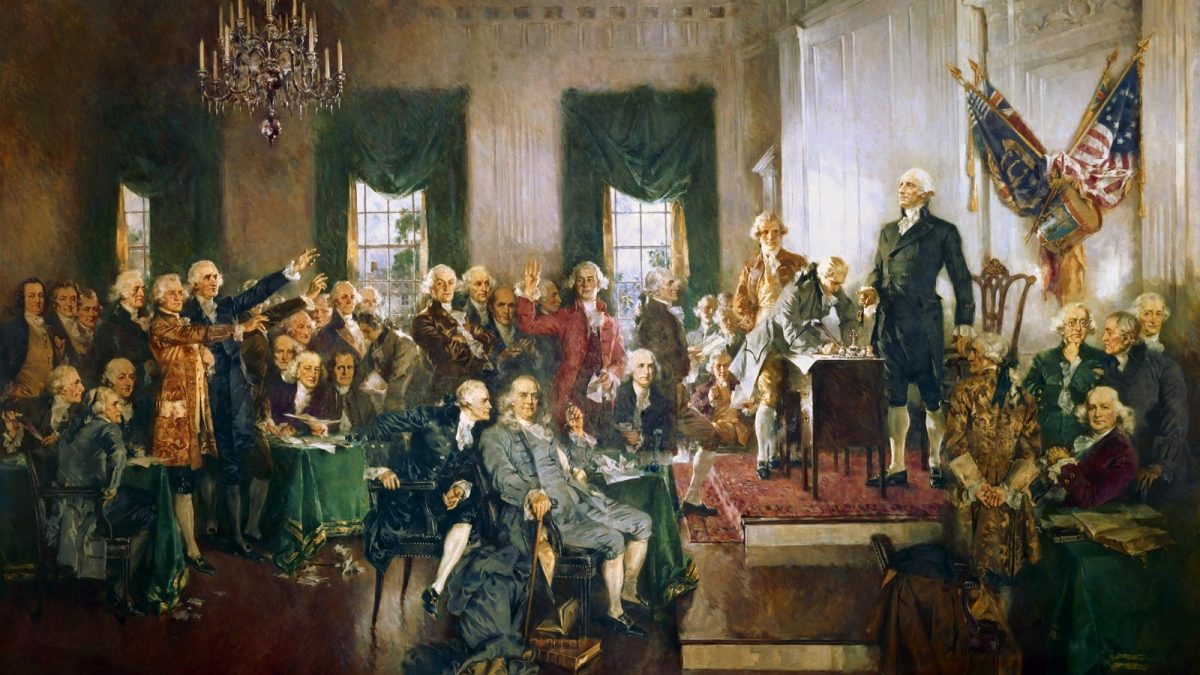
On the last day of the Constitutional Convention, Sept. 17, 1787, George Washington rose from the president’s chair and spoke on a question for the only time that summer. Nathaniel Gorham of Massachusetts had moved to shrink a House district from 40,000 people to 30,000, and George Washington told the delegates the larger number had “always appeared to himself among the exceptionable parts of the plan” and that he wished the change made. The delegates agreed without a dissent, and the number went into Article I: the House shall not exceed one for every 30,000 people. The United States has about 346 million people now, so one representative for every 30,000 of them, the ratio George Washington asked for, comes to about 11,500 seats. The case for a House of about 11,000 members rests on the people a representative talks to every day.
People’s behavior, thoughts, worldview and beliefs are largely shaped by the people they interact with, and researchers have measured how much a person’s circle changes what that person does and believes. Nicholas Christakis, the physician and sociologist who ran the social network studies at Harvard Medical School, and James Fowler, a political scientist at the University of California, San Diego, tracked the Framingham Heart Study’s social network for decades, 4,739 people over 20 years in the happiness study alone, and found that happiness, obesity, smoking and drinking spread through friendships three degrees out, to a friend of a friend of a friend, and no further. Alan Gerber and Donald Green, the Yale political scientists whose field experiments built modern turnout research, mailed Michigan households before the 2006 primary with Christopher Larimer and found that showing people their neighbors’ voting records raised turnout 8.1 percentage points, against 1.8 points for a mailer that appealed to civic duty. Joshua Kalla and David Broockman, political scientists then at Berkeley and Stanford, found in 2016 that a 10-minute conversation at the door reduced prejudice against transgender people for at least three months. Robin Dunbar, the Oxford evolutionary psychologist, put the number of stable relationships a human brain can hold at about 150. A representative is a person, and the people in front of a representative change that representative the way anyone’s circle changes them.
A House member with 30,000 constituents sees the same people their constituents see: the barber, the school board, the union hall, the one grocery store. A House member with 800,000 constituents cannot know the district, so the people they talk to every day are the people who can get through to them: donors, staff, lobbyists and party leadership. One hundred fifty people who each know 150 people is 22,500, so in a district of 30,000 the representative is a friend of a friend to nearly everyone in it. In a district of 800,000, most constituents know nobody who knows the representative, and Christakis and Fowler found no effect at all past the third degree. The argument for expansion inverts that arrangement: the official closest to voters would hold the most power, because that official is the one constituents and the people they know can reach, call and look in the eye at a meeting on a Tuesday night.
Congress set the district at its current size with one statute. In 1910 the country had one representative for every 209,447 people, by the count of Drew DeSilver of the Pew Research Center. The 1920 census showed the population had moved to the cities, members from rural districts blocked reapportionment for a decade because the cities would have gained representatives at their expense, and the Permanent Apportionment Act of 1929 fixed the House at 435. The average district now holds nearly 800,000 constituents, more than 25 times the ratio George Washington asked for. Among the 35 OECD countries the United States has the most people per lower-house member, about 747,000 in 2018, with Japan next at 272,108 people per member. The American Academy of Arts and Sciences’ Our Common Purpose commission, in a report by Lee Drutman, Jonathan Cohen, Yuval Levin and Norman Ornstein, counts Britain’s House of Commons at 650 members, about 101,000 people each, and reports that the cube-root rule that predicts the size of most legislatures predicts 692 seats for the United States. Every expansion bill filed in Congress aims at numbers like that, and 692 seats is a district of half a million people, still a crowd the representative will never meet.
Brian Frederick, a political scientist at Bridgewater State University, measured what a bigger district does to the people in it. He matched national election surveys from 1980, 1990 and 2000 to district populations in American Politics Research in 2008 and found that every 100,000 constituents added to a district cut constituents’ warmth toward their representative 2.4 points on a 100-point scale, that contact from the representative fell from 82 percent in the smaller districts to 76 percent in the larger ones, and that the share calling their representative very helpful fell from 32 percent to 25 percent. The larger districts in his comparison held 663,000 people. Today’s average holds 800,000 people. One state already runs its lower house at a far smaller ratio than Article I’s. New Hampshire’s House has 400 members for about 1.4 million people, about 3,300 per representative, the largest lower house of any state and the smallest ratio in the country, and it pays each member $100 a year. A New Hampshire representative is someone constituents see at the hardware store, and the state has governed itself that way since its first House sat in 1776 with 87 members.
A House of 11,000 is harder to buy than a House of 435. Buying a majority of 435 means buying 218 people whose ads somebody else paid for. Buying a majority of 11,000 means buying 5,501 of them, each one answerable to 30,000 neighbors who will see them at the grocery store the next morning. The same arithmetic applies to the staff who read the bills. Protect Democracy and the POPVOX Foundation, in their December 2024 report on what expanding the House would take, counted about 31,000 employees in the entire legislative branch overseeing a federal workforce that passes 9 million with contractors counted, after Congress cut its own staff starting around 2000. Eleven thousand members with two staffers each would double the number of people on Capitol Hill reading what those 9 million do.
A district of 30,000 people is about 12,000 households, and one candidate with 20 volunteers can knock every door in it in a year, so the campaign is won at the door, by the neighbor-to-neighbor contact Gerber and Green measured. Television ads for 30,000 people make no sense, so a rich candidate’s advantage shrinks to what it is in a school board race. A map drawn around 30,000 people is a neighborhood, and there is little to gerrymander in a neighborhood. The Electoral College changes by arithmetic: electors are House seats plus 100 senators plus three for the District of Columbia, so at 11,000 House seats the Senate’s 100 electors fall under 1 percent of the college and each state’s weight becomes its share of the population. Wyoming, with 577,719 people, holds 0.17 percent of the country and 0.56 percent of the Electoral College today; at one seat per 30,000 it holds about 0.19 percent, while California rises from 10 percent to about 12 percent. The two electors every state gets for its senators, which put George W. Bush ahead of Al Gore in 2000, stop deciding elections, with no constitutional amendment required. The cost at the current House salary of $174,000 is $1.9 billion a year, about $5.50 per American, and New Hampshire shows the salary is a choice.
It takes one law, because one law capped the House at 435. Congress capped the House by statute in 1929 and can uncap it by statute. Rep. Haley Stevens, a Michigan Democrat, introduced H.R. 2797, the House Expansion Commission Act, on April 9, 2025. It would seat a 13-member commission, none of them sitting members of Congress, to study expansion and report within two years, including the cube-root rule and the Wyoming Rule, and its findings cite the 585-seat bill Rep. Earl Blumenauer of Oregon filed in the last Congress, the REAL House Act, which would add 150 seats. Five hundred eighty-five seats is a district of about 590,000 people, 20 times George Washington’s number. The bill sits in the House Judiciary Committee.
One statute did all of it. In 1929, members from rural districts froze the House at 435 so the cities would not gain seats, and that vote took the representative out of the neighborhood and put 800,000 people between a voter and the person who votes in that voter’s name. At 30,000 people per district, the ratio George Washington asked for and the delegates wrote into Article I without a dissent, the representative is a friend of a friend to nearly everyone they answer to, a campaign is won by knocking 12,000 doors, and the two Electoral College votes every state gets for its senators shrink from two of Wyoming’s three to two of its 21, so each state’s weight in the presidential count tracks its population. New Hampshire has run a 400-member House at $100 a year since 1776. Congress passed the 1929 law by majority vote, and a majority vote repeals it.
Originally published on The Existentialist Republic (Substack).
Related: Why I Want 11,000 Members of the U.S. House (The Existentialist Republic)
Join the discussion on r/ExistentialRepublic